
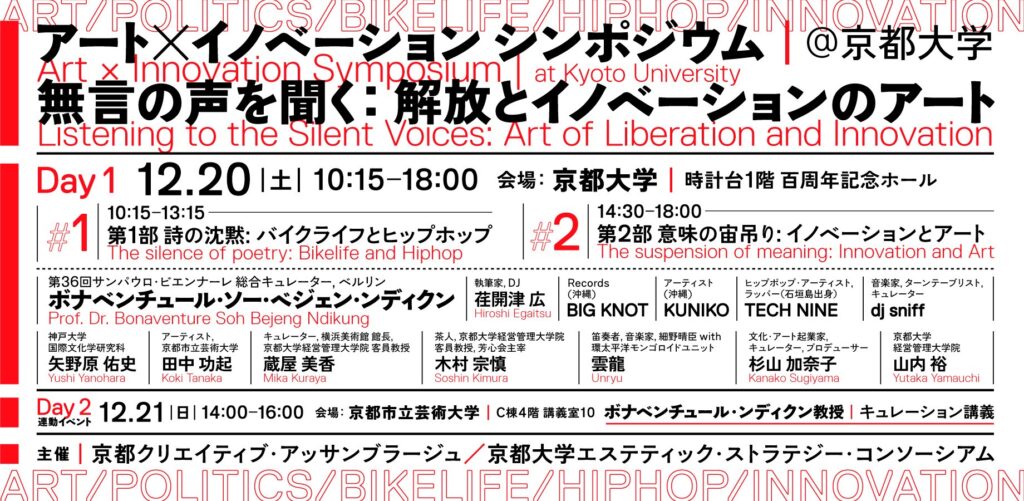
Statement – Listening to the Silent Voices: Art of Liberation and Innovation
12月20日のシンポジウムの考え方をまとめたものです。シンポジウムの詳細はこちら。This is the statement for the symposium on Dec 20, 2025, at Kyoto University. You can find details here (sorry only in Japanese).
https://artxinnovation-kyoto.peatix.com
バイクライフとヒップホップ BikeLife and Hip-hop
無言の声は、支配的な意味のシステムから排除され、意味が与えられず、声にならない音として無視される。音を出しても雑音としてしか聞かれない。システムから排除され、意味が与えられない、むしろ存在を与えられないもの。この排除された非-存在の場所から、どのような声を上げることができるのか? バイクライフやヒップホップを生み出しているアメリカのアフリカ系の人々の直面する現実である。
“Silent voices” are those excluded from dominant systems of meaning—denied intelligibility, left without recognition, treated as voiceless noise even when they do make sound. They are not only stripped of meaning but, in a deeper sense, refused being. From this excluded position of non-being, what kind of voice can be raised? This is a reality faced by many African American communities that have generated both BikeLife and hip-hop.
バイクライフは、レース用のオフロードバイクを、前輪を上げてウィリーして乗る「スポーツ」である。どれだけ長くウィリーできるのか、あるいは様々なトリックを競う。インスタグラムで映像が拡散し、世界中の若者が熱狂している。アメリカ東海岸ニューヨークやボルチモアで始まり、ヨーロッパでも、アフリカでも。
BikeLife is a “sport” in which riders perform wheelies—lifting the front wheel of an off-road racing motorcycle—and compete over duration and technique, including a range of tricks. Videos circulate widely on Instagram, fueling enthusiasm among young people across the globe. Originating on the U.S. East Coast—in places such as New York and Baltimore—it has spread to Europe and Africa as well.
頼み込んでシステムの内部に入り込み、声を上げたらいいのだろうか? それでは、自分を排除してきたシステムを肯定することになってしまう。逆に、システムの外に留まり反発すればいいのだろうか? それこそがシステムが望んだことではないか。犯罪者扱いされ、システムの排除を正当化してしまう。だから排除しなければならないんだ、と。どちらも選択できない—ダブル。どちらかを選択するのではなく、倍加 (redouble)しなければならない。
Should you plead for entry into the system and then speak from within? Doing so risks affirming the very system that has excluded you. Should you remain outside and resist? That, too, may fulfill the system’s expectation: you are labeled a criminal, and the exclusion is thereby “justified.” You cannot simply choose either option—double. The task is not to select one side, but to redouble it.
アメリカの黒人の方々がアフリカのアイデンティティを主張することは、排除されたアイデンティティを固定化してしまうし、排除自体を必要としてしまう。人種主義と闘うためにアフリカのアイデンティティを掲げたパイオニアW.E.B.デュボイスは、後に自分が人種主義を「欲望」してしまっていたことを打ち明けている。一方で、人種など存在しないと説くことは、システムを批判するための足掛かりを失うことになる。人種が関係ないのだから。
Chandler, N. D. (2013). X―The Problem of the Negro as a Problem for Thought. American Literatures Initiative.
When Black Americans assert an “African identity,” this can inadvertently fix an identity that was produced through exclusion—and even render exclusion necessary. W.E.B. DuBois, a pioneer who once raised African identity in the struggle against racism, later confessed that he had come to “desire” racism. Yet to insist that race does not exist is also to lose a foothold for critique, because then race does not exist and would “not matter.”
Chandler, N. D. (2013). X―The Problem of the Negro as a Problem for Thought. American Literatures Initiative.
そもそもシステム自体を受け入れてはいけない。しかし、システムを受入れなければ、犯罪者扱いされてしまうが、これも受け入れてはいけない。ギャングなのではない。ギャングはシステムに明示的に対立する。しかし排除されたものは、対立することもできない。ギャングはシステムの内部に場所を持っている。この排除の問題を解決することはできない。解決という用語は、システムのものだ。解決できるという考え方自体が、排除を生み出している。
In principle, you must not accept the system. Yet if you do not, you are treated as a criminal—and that, too, must not be accepted. This is not “gang” identity. Gangs explicitly oppose the system, but the excluded cannot even take up the position of opposition. The gang still has a place inside the system. Nor can this exclusion simply be “solved,” because “solution” is itself a term of the system. The very idea that the problem can be solved is part of what produces exclusion.
システムが徐々に場所を奪っていく。地価が上がり、高級アパートが作られる。町の真ん中に空間を切り開くしかない。しかし荏開津広は、それは単なる「ストリート」ではないと言う。「解放された公共圏」、「道路や公園や寂れたバーや改造されたローラースケート・リンクという空間に魔術のように、つまりパーティの続く間だけに限ってだが現出させる」空間を切り開くのがヒップホップである。
荏開津広. (2023)「セックス・マシン/ポエティッ ク・ジャスティス」『HIP HOP 50 ISSUE: ヒップホップ誕生50周年記念号 100枚の名盤ガイド』(小淵晃編) Pヴァイン, pp. 124–128.
As the system gradually takes space away—land prices rise, luxury apartments appear—you are forced to carve out space in the middle of the city. Yet Hiroshi Egaitsu argues that this is not merely “the street.” Hip-hop opens what he calls a “liberated public sphere”: a space “conjured, almost magically, within roads, parks, rundown bars, or repurposed roller rinks—appearing only for the duration of the party.”
Egaitsu, H. (2023). “Sex Machine/Poetic Justice.” In A. Obuchi (Ed.), HIP HOP 50 ISSUE. P-Vine, pp. 124–128. (in Japanese, translated by me)
何かを自分のこととして主張すると、盗んだと言われる。それなら盗むしかない。もちろん違法なことはしてはいけない。違法なことはやめろと言われて、違法なレース用バイクではなく合法なバイクに変えてみたが、同じように警察にチェイスされた。違法だからチェイスされているのではない。チェイスされるから違法になる。公道でも走れるようにバイクを改造し登録する。それでもチェイスされるから、常にスパイカメラをつけて警察の動きを記録する。
When you claim something as your own, you may be accused of stealing it—so you end up having to steal. Of course, you must not do anything illegal. Yet even when riders switched from illegal racing bikes to street-legal bikes, they were chased by police in the same way. They are not chased because they are illegal; they are illegal because they are chased. Riders modify and register bikes to be street-legal, and still they are chased—so they attach spy cameras, recording police movements continuously.
モーテンが言うように、逃走すること(fugitivity)の政治はひとつの可能性と言えるだろうか。システムには捉えられない速さで移動しよう。逃げるのではなく、システムの論理を拒否する。イエスともノーとも言わないこと、そのような選択すら拒否すること、例えばイエスと言いながらノーと言うこと、質問を攪乱すること。
Moten, F., & Harney, S. (2016). the undercommons: Fugitive planning & black study. Minor Compositions.
Could the politics of fugitivity, as Moten suggests, offer a possibility here? Move at a speed the system cannot capture. Not as mere flight, but as refusal of the system’s logic: neither “yes” nor “no,” refusing even the terms of choice—saying “yes” while also saying “no,” disrupting the question itself.
Moten, F., & Harney, S. (2016). The Undercommons: Fugitive Planning & Black Study. Minor Compositions.
理路整然としたシステムの言葉を用いた反論は、システムをより強化するだろう。不透明さ(opacity)を選ぶこと。返事をするのではなく、聞こえていないふりをする。理解していないふりをする。理解していないことこそが、理解の本当の意味だ。植民者から押し付けられた言葉を攪乱して使うクレオールの言葉は破壊的である。
グリッサン, É. (2024)『カリブ海序說』(星埜, 塚本 & 中村訳)インスクリプト.
A rational rebuttal articulated in the system’s language may only strengthen the system. You might instead choose opacity: not responding, pretending not to hear, pretending not to understand. Not understanding is, in a sense, the true meaning of understanding. Creole language, which destabilizes the colonizer’s imposed tongue by twisting it, can be destructive in precisely this way.
Glissant, E. (1992). Caribbean Discourse: Selected Essays (J. M. Dash, Trans.). Univ of Virginia Pr.
声を出しても聞かれないし、聞かれる声はシステムにとって都合のよいものだけだ。雑音こそが本当の声だ。こすって音を出せ。普通の音では意味がない。音量の限界を越えた音量。うるさい、という声すらも聞こえないように。
Even when you speak, you are not heard; and when you are heard, it is only the voice convenient to the system. Noise, then, may be the real voice. Rub to produce sound. Ordinary sound carries no force. Turn the volume beyond its limits—so that even their complaints can no longer be heard.
バイクはウィリーすると壊れてしまう。しかし、バイクは自分たちがウィリーするため作られたものだ、そうとしか考えられないように作られている。メインのボーカルも楽器も消えた、誰も興味を示してこなかったブレイクビートだけを使おう。ターンテーブルを使って交互に。
Wheelies break bikes. And yet the bike seems built as if it exists for wheelies—so convincingly that it becomes difficult to think otherwise. Likewise, use only the breakbeat: a fragment that few cared about, from which the main vocals and instruments have ceded. Alternate it with two turntables.
バイクライフの人々は、政治的な意図はなく、ただ楽しみたいだけだと言う。しかし、ただ楽しむことなど許されない。楽しむということが許されていないのだから、ただ楽しむということが抵抗なのだ。 どうしても政治的にされてしまう。
Riders often insist they have no political intention; they just want to have fun. But “just having fun” is not permitted. Precisely because enjoyment is disallowed, enjoyment becomes resistance. You are made political against your will.
ヒップホップもバイクライフも、売れて金持ちになることは、システムに迎合し、それをより強化するだけだ。しかし、売れないことが正義か? それはシステムが望んだことだ。貧乏でみじめな姿こそシステムを喜ばせる。売れてはいけないという論理こそシステムの作ったものだ。だから売れなければならない、しかし…
In both hip-hop and BikeLife, “making it,” becoming commercially successful and wealthy, can look like aligning yourself with the system that has excluded you—accepting its standards of value, its pathways to recognition, and its rules for what counts as legitimate. But the opposite stance—refusing success, or treating “not selling out” as the only ethical position—also falls into a trap. If you remain poor and marginal, the system can treat that outcome as confirmation of your “proper place.” Misery becomes part of the story that stabilizes exclusion. So you need to sell, but…
カメルーンで研究する文化人類学者の矢野原佑史によると、 現地のラッパーたちは、伝統的な音楽や言語を利用し、土地に根差したヒップホップを生み出している。「ヒップホップとカメルーンの伝統音楽は同じ“木”から派生したもの」だという。そして、「自分がスピットする(ラップする)言葉ひとつひとつが神に届けられるものだ」と。しかしこの言葉のもつ霊性は、アフリカン・アイデンティティを固定化するものではないだろう。意味が切断されたときに霊性が現れる。アイデンティティからあふれ出る過剰に駆り立てられた言葉にこそ言霊が宿ると考えられないだろうか。
矢野原佑史(2025)「ラップにこめる霊力と世界の変革──カメルーンのラッパーたち」『季刊民族学192 特集 ヒップホップ:逆転の哲学』(ダースレイダー編)千里文化財団 (pp. 54–61).
Rappers in Cameroon draw on traditional music and language to produce a locally rooted hip-hop, according to Yushi Yanohara. They say that “hip-hop and Cameroonian traditional music branch from the same ‘tree,’” and that “each word we “spit” is delivered to God.” Yet the spirituality here need not fix an African identity. Spiritual force appears when meaning is cut. Might you not say that a kind of word-spirit dwells precisely in words driven beyond identity—words overflowing as excess?
Yanohara, Y. (2025). “Spiritual Power in Rap and the Transformation of the World: Cameroonian Rappers.” Kikan Minzokugaku 192. Senri Foundation, pp. 54–61. (in Japanese, translation by me)
なぜ前輪を上げてウィリーするのか? 常に動いていることが重要だ。安定していると、システムに捉えられてしまう。他の車のトラフィックを縫うように走る。システムの割れ目を探して走る。スタイルを持って、システムの線形の流れに亀裂を入れる。
Why wheelie? Because constant motion matters. If you stabilize, the system captures you. You weave through traffic, searching for cracks in the system. With style, you open fissures in the system’s linear flow.
公道をウィリーして走りながら、子どもたちには公道を走るなと指導する。バイクライフのライダーたちは、子どもたちのためにバイクを購入し、無償のウィリースクールを運営している。なぜだろうか? 子どもたちがバイクに熱中すれば、ギャングの活動に引き込まれないからだ。バイクが自分を救ってくれた、と言う。
Riders do wheelies on public roads while telling children not to ride on public roads. They buy bikes for kids and run free wheelie schools. Why? Because if children commit to bikes, they are less likely to be drawn into gang activity. Riders say: the bike saved me.
dj sniffは、戦争の終焉を告げた昭和天皇の玉音放送を掘り起こす。天皇の声は、ほとんどの人には何を言っているのかわからなかった。国民や植民地の人々は天皇の声をはじめて聞いただけではない。天皇が国民に呼び掛けたのは初めてだった。だからどういう言葉を使うのかすらわからず、結局、漢文を日本語読みした。天皇が自分をどう呼ぶのかすらも決まっていなかった—結局、「朕」と呼んだ。天皇の声はその場で作り上げられた。そもそも存在しなかった。
dj sniff diggs the imperial rescript broadcast–Jewel Voice–that announced the end of the war. Most listeners could not understand what was being said. It was not only that they were hearing the Emperor’s voice for the first time; it was also the first time the Emperor addressed the people. Even the choice of language was uncertain—ultimately it was delivered in a Japanese reading of classical Chinese. Even how the Emperor should refer to himself was undecided—eventually he used “chin.” The Emperor’s voice was produced right in the moment. In a sense, it did not exist.
NHKの職員がターンテーブルのペアを2セット使って録音した。1枚のディスクには3分しか録音できないので、もう一台に切り替えながら。そして、万が一のためのバックアップがもう1セット。無事録音が終って編集と放送のためにNHKに戻ろうとしたとき、降伏することに反対する軍の一部に拘束された。なんとか切り抜け、隠れて放送の準備をした。2台のターンテーブルを切り替えながら。玉音放送を流したのはターンテーブリストだった。放送は、植民地全体に届けるため6倍のシグナルに増幅させたため、雑音がひどかった。聞こえるはずもない。
NHK staff recorded it using two pairs of turntables. Since one disc could hold only about three minutes, they switched between machines; another pair served as backup. On their way back to NHK for editing and broadcast, they were detained by a faction within the military opposed to surrender. They escaped, prepared the broadcast in hiding, and again switched between two turntables. The broadcast was performed by a turntablist. To reach the entire colonial empire, the signal was amplified sixfold, producing heavy noise—hardly something that could be “heard.”
玉音放送の録音は、米軍が到着するまでに破壊するように命令されていたが、NHKの技術者はディスクを守って保管した。GHQからディスクを提出するように要請されたとき、この技術者は秘密裏にコピーを作成した。正式に保管されていたディスクは20年以上後に発見されたときにはひび割れており復旧できなかった。そこで秘密に個人で保管されていたディスクだけが残されていたのである。それも本来の玉音放送とは微妙にピッチが合っていない。玉音放送は存在しない。
Although the recording was ordered to be destroyed before U.S. forces arrived, an NHK engineer protected the discs. When GHQ requested, the engineer secretly made a copy. By the time the official disc was discovered more than twenty years later, it was cracked beyond restoration. Only the privately preserved disc remained—and its pitch does not perfectly match the “original.” The Jewel Voice does not exist.
天皇の声は単なるひとりの声ではない。そもそもそのような声は存在しない。権力、技術、言語、情熱、政治、偶然が絡み合って出現した。これを聞く人は、もはや聞いていない。dj sniffは、この放送が流れた「台湾」と「日本」のふたつのトラックをパラレルに構成する。台湾のトラックは、中国語に訳されて読み上げられたものがサンプリングされている。
dj sniff (2022) Parallel traces of the jewel voice.
The Emperor’s voice was never merely one person’s voice; such a voice, strictly speaking, never existed. It emerged as a knot of power, technology, language, passion, politics, and contingency. At that point, you are no longer simply “listening.” dj sniff constructs two parallel tracks—“Taiwan” and “Japan”—and samples the Chinese translation read aloud on the Taiwanese track.
dj sniff (2022). Parallel traces of the jewel voice.
ブラックネス Blackness
意味のシステムの内部は、理路整然としたカテゴリで語られることができ、安心することができる。その中にある全てのものは、明確な意味が与えられる。もちろんよりよいもの、よくないものの差は作られるが、意味は与えられている。
Inside the system of meaning, you can speak through orderly categories and feel secure. Everything receives a clear meaning. Differences between “better” and “worse” are produced, but meaning is nonetheless assigned.
この明確なカテゴリを成立させるために、システムを閉じなければならなかった。カテゴリには収まらない、不都合なものを排除した。排除されたものは、おぞましいものとして忌避された。それがアナーキーな力のあふれるブラックネス。これは黒人という意味ではない。
To establish these categories, the system had to close itself—to exclude what does not fit, what is inconvenient. The excluded is shunned as something dreadful or abject. That excluded force overflowing with anarchic energy is what could be called “blackness”—not in the sense of Black people, but as the name for that excluded excess.
ブラックネスは、クイア、移民、シングルマザーにも、そして沖縄にもある。横浜にもある。さらには、自分たち全員にも少しずつある。このようなトラウマ的排除を容易に相対化してはいけないが、そう考えたい。多様性とは何か? 違うものが揃っているということではない。ブラックネスのことだ。
Blackness is also present in queer life, migrants, single mothers, and Okinawa; it is present in Yokohama; and, in some measure, in all of us. You must not relativize traumatic exclusion lightly—but I want to think in these terms. What is diversity? It is not the mere arrangement of differences. It is blackness.
しかし、同時に閉じられた意味のシステムは、それ自体では空虚である。全てに意味が与えられるが、それはあらかじめ作られたシステムの中で位置を占めているに過ぎない。意味のシステムの中で与えられた意味では、本当の自分を感じられない。自分はそんなんじゃない。
At the same time, a closed system of meaning is empty in itself. Everything is given meaning, but only insofar as it occupies a position within a pre-fabricated structure. Meaning assigned by the system does not let you feel your true self: I am not that.
人々は、安心するためにシステムを閉じたが、そのとき同時に排除されたものに魅了されてもいたのだ。なぜなら、本当の自分はカテゴリには収まりきらないと感じていただから。しかしこの過剰は自分を不安にも落し入れた。だから排除して安心したが、実は過剰に魅せられてもいた。
People closed the system to feel secure, but they were simultaneously fascinated by what they excluded—because they sensed that their true selves cannot be contained by categories. Yet this excess also unsettled them. So they excluded it for reassurance, even while being captivated by it.
だから人は排除したおさまり切らない過剰を神秘化し、それを欲望する。しかし、それを恐れてもいるから排除する。排除しておいて欲望する。好きだということほど、恐しい嫌悪はない。システムがブラックネスを作り出すのではない。ブラックネスがシステムを可能にしている。
Thus people romanticize what they excluded and desire it. But because they also fear it, they exclude it. They exclude it and desire it at once. There is no hatred more terrifying than the hatred that accompanies love. The system does not create blackness; blackness makes the system possible.
何もしない政治はあるだろうか。「しないことを選びたい」を繰り返すバートルビー(メルビルの小説の登場人物)を実践する政治。何もしない受動的であるということはシステムの思うつぼだが、反発して抵抗することも、すでにシステムが折り込みずみである。システムはそのような抵抗に、自らの欲望を映し込み神秘化することで、自らの欲望を満たしている。それなら、そのような欲望を拒否しなければならない。つまり、抵抗しないこと、何もしないことによって、欲望を骨抜きにする。
ジジェク, S. (2010)『パララックス・ヴュー』(山本耕一訳)作品社.
Is there a politics of doing nothing? A politics of Bartleby, who repeats, “I prefer not to,” as a practice. Pure passivity may be exactly what the system wants; yet overt resistance is also already anticipated by the system. The system romanticizes resistance by projecting its own desire onto it, thereby satisfying itself. If so, that desire must be refused—by not resisting, but by doing nothing, by hollowing out desire itself.
Žižek, S. (2009). The Parallax View. MIT Press.
このアートはみんなのものだ。本当にそう思う。しかしこの「みんな」には、ただ消費したいだけの人々は含まない。そういう人々はこのアートを神秘化し、そもそもこれをアートたらしめている排除を欲望しているのだから。
This art belongs to everyone—this I genuinely believe. Yet “everyone” does not include those who only want to consume. Such people romanticize the art and desire the exclusion that makes it art in the first place.
本来のみんなとは誰だ? 誰でもない。みんな=nobody=排除され存在を与えられないもの。もしみんなを数え上げるなら、それを数え上げている人は、自分は数えられなくてもいい特権を持っている。それが欺瞞なら、本当に「みんな」と言えるのは、排除された位置からだけだ。そして、この排除した位置に立つことのできるみんなのもの。
Who, then, is “everyone”? Nobody. Everyone = nobody = those excluded and denied existence. If you can enumerate “everyone,” you hold the privilege of not needing to be counted. If that is deception, then the only place from which you can truly say “everyone” is the excluded position—and the art belongs to everyone who can stand there.
アートの政治 Politics of Art
エステティックス=美学とは、何が感じられ、何が感じられないのかを決定する感性のシステムを宙吊り=中断することだ。それにより、声が聞かれなかったもの、感じられなかったものが、感じられる可能性を拓く。 意味あるものを生み出してはいけない。なぜなら、意味あると言っている時点で、意味のないものを想定しているのだから。意味があるという階層構造を作り上げてしまっている。意味を宙吊り=中断しなければならない。
ランシエール, J. (2009)『感性的なもののパルタージュ』(梶田裕訳)法政大学出版局.
Aesthetics is the suspension—the interruption—of the sensible system that decides what can be felt and what cannot. It thereby opens the possibility that what had no voice, what could not be sensed, might become sensible. You must not produce “meaningful” things, because to declare something meaningful already presupposes something meaningless and reinstates hierarchy. Meaning must be suspended.
Rancière, J. (2006). The Politics of Aesthetics (G. Rockhill, Trans.). Bloomsbury Academic.
アートは、意味を切断するのであり、意味を生み出すのではない。だからアート作品はワケわからない。意味のシステムを解体しているのだから、ワケわからないことこそが解放だ。「ペットボトルの水で最寄りの原子力発電所からの距離を地面に書く。」
蔵屋美香『第55回ヴェネチア・ビエンナーレ国際美術展 日本館の提案』
Art cuts meaning; it does not produce meaning. That is why artworks feel incomprehensible. Because they dismantle the system of meaning, incomprehensibility itself can be emancipation. “Using bottled water, write on the ground the distance to the nearest nuclear power plant.”
Kuraya, M. Proposal for the Japan Pavilion, 55th Venice Biennale. (in Japanese)
Bonaventureは、第36回サンパウロ・ビエンナーレで、「Not All Travellers Walk Roads: Of Humanity as Practice」を掲げた。
36th Bienal de São Paulo. (2025). Reader—Not All Travellers Walk Roads Of Humanity as Practice.
At the 36th Bienal de São Paulo, Bonaventure presented the theme “Not All Travellers Walk Roads: Of Humanity as Practice.”
36th Bienal de São Paulo. (2025). Reader—Not All Travellers Walk Roads Of Humanity as Practice.
Not all travellers
walk roads,
there are submerged worlds
that only the silence
of poetry penetrates.
Conceição Evaristo, “Da calma e do silêncio,” in Poemas da recordação e outros movimentos. Rio de Janeiro: Malê, 2008, p.122.
詩の沈黙にしか到達できない領域がある。「アンダーコモンズ」と呼ばれる領域であり、システムの論理には理解できない領域。イエスもノーも決まらないアナーキーな領域。そのような領域はいたるところにある。しかし、きれいな声はそこに届かない。システムには捉えられないスピードで動く必要があるが、同時にシステムの超自我は動け、話せと命令もする。歩かないこと、沈黙すること、何もしないことの政治。
Moten, F., & Harney, S. (2016). The undercommons: Fugitive planning & black study. Minor Compositions.
There are worlds accessible only through the silence of poetry—domains called the “undercommons,” unintelligible to the system’s logic: anarchic spaces where neither “yes” nor “no” is settled. Such spaces are everywhere. Yet a “clean” voice does not reach them. While you must move at a speed the system cannot capture, the system’s superego commands: move, speak. Hence a politics of not walking, of not speaking, of doing nothing.
Moten, F., & Harney, S. (2016). The Undercommons: Fugitive Planning & Black Study. Minor Compositions.
アートは批判する。しかしアートは、何かを批判するための安全な場所に逃げ込まない。そもそも批判するものが立つ位置すらもわからないような批判が必要だ。これがシステムを解体する批判だ。アートの美しさは、自ら安全な位置にいて他者を批判する、あるいは自分を絶対的に正しい場所に固定し他者を批判する「美しい魂」を告発する。もちろん、この告発自体も問題としながら。
Art criticizes. But it does not retreat to a safe position from which to criticize. What you need is a critique whose very standpoint becomes unclear—a critique that dismantles the system itself. The beauty of art is that it exposes the “beautiful soul” that criticizes others from a secure position, or fixes itself as absolutely correct and condemns others—while also problematizing this exposure in turn.
蔵屋美香と田中功起による2013年ヴェネチア・ビエンナーレの展示は東日本大震災の2年後に行われた。震災とそれが浮き彫りにした社会の様々な問題をつきつけられたとき、被災地に入り、その強烈な現実に根差したアートがありうる。蔵屋と田中は、このような批判から距離を取った。誰もが同意する現実という揺ぎないものに軸足を埋め込み固定する批判の危うさがある。そのような批判はとても力強く人々に訴えかけるし、社会をゆさぶる革新性がある。しかし、誰も反論できない強い土台を持つことは、そのような強さのロジックに合わせることのできない多くの人を排除する。
田中功起(2014)『必然的にばらばらなものが生まれてくる』武蔵野美術大学出版局.
The Venice Biennale exhibition by Mika Kuraya and Koki Tanaka in 2013 took place two years after the Great East Japan Earthquake. Faced with the disaster and the social problems it revealed, you might pursue art rooted in the intense reality of affected regions. Kuraya and Tanaka distanced themselves from that form of critique. There is a danger in criticism that anchors itself in an “undeniable reality” shared by all. Such critique can be powerful and socially transformative, yet a critique built on an unassailable foundation also excludes those who cannot align with the logic of that strength.
Tanaka, K. (2014). Hitsuzen-teki ni Barabara na Mono ga Umarete Kuru. Musashino Art University Press. (in Japanese, translated by me)
それではどういう批判が可能だろうか? 私たちの何気ない日常の奥底にある恐しい不気味な領域がある。社会を批判するために、別様の社会を想像(image)することが必要であるなら、本来のイマジナリー(imaginary)はこの奥底のマグマのことではないか。意味作用が成立する前に存在する意味の成立しない領域。理路整然としたカテゴリという軸足には収まりきらず、それを脅かすようなアンダーコモンズとも言える。それを捉える批判は、強固な土台に軸足を持つよりも強い批判となりえる。なぜなら現実の中の問題への批判ではなく、現実を全体として問題とし、その現実の中には現われない問題への批判となりうるから。
カストリアディス, C (1994)『想念が社会を創る: 社会的想念と制度』(江口幹訳) 法政大学出版局.
What kind of critique, then, is possible? Beneath ordinary daily life there is a frightening uncanny domain. If social criticism requires imagining a different society, then the true “imaginary” may be this magma beneath—an area prior to signification, where meaning does not yet hold. It cannot fit within orderly categories; it threatens them. It is, in another sense, an undercommons. A critique that grasps this may be stronger than critique that relies on firm ground—because it is not merely critique of problems within reality, but critique of reality as a whole, including problems that do not appear within it.
Castoriadis, C. (1998). The imaginary institution of society. MIT Press.
他者とわかりあう Understanding the Other
本当に他者とわかりあうということはどういうことだろうか? それは他者を理解してあげることではない。他者を自分の世界に引き入れることではない。一方で、他者の世界に押し入ることでもない。 自分の世界と他者の世界がふたつあるとして、それが対等に並べられるなら、それは理解したことにはならない。対等に並べる人はどこにいるのだろうか? その人はこれら二つの世界を上から見ている別の世界にいる。ひとつの世界に他の世界を収めてしまっている。対等ではない。
What does it mean to truly understand the other? It does not come from a kindness–condescending. Nor to bring them into your own world; but neither is it to invade their world. Even if you imagine two worlds—yours and the other’s—placing them side by side “equally” is not understanding. Where is the person who can arrange them equally? That person must stand in a third world, looking down from above—already containing the two worlds within one, and thus making them unequal.
他者の世界を理解することは、自分の世界の限界・不可能性を理解することである。自分の世界には、それで完結できない何か異質なものがある、ということを理解する必要がある。自分に最も近いと思ったものは、実は自分から最も遠いものだと理解すること。つまり到達できない未知がある。それを共有することはできないが、だからこそ共有しなければならない。
To understand the other’s world is to understand the limits—the impossibility—of your own. You must recognize that within your own world there is something heterogeneous that cannot be completed. What seems closest to you may in fact be the farthest from you. There is an unreachable unknown. You cannot share it; and precisely for that reason, you must share it.
自分の世界が不可能であること、つまり自分自身の不可能性こそが多様性である。多様なものを並べることではない。本当の多様性はシステムから排除されながら、そのシステムを構成してもいる未知の無-意味な外部の位置にしかない。「多様性…についてのほとんどの言葉や美学がスローガンの裡に息絶えて届かないとき、結局は凡庸な日常でよく目にすることやモノを表す連なりでしかないはずの、プレイクビーツと呼応する言葉が、グラフィティが、プレイキンだけが政治性を帯びたまま、つまり階級意識をなおざりにせずにグローバルに蔓延っていく。」(p. 127)
荏開津広. (2023)「セックス・マシン/ポエティッ ク・ジャスティス」『HIP HOP 50 ISSUE: ヒップホップ誕生50周年記念号 100枚の名盤ガイド』(小淵晃編) Pヴァイン, pp. 124–128.
The impossibility of your world—your own impossibility—is diversity. Not the equal arrangement of diverse things. True diversity lies only in the position of an unknown, non-meaningful exterior that is excluded by the system while also constituting it. “When most discourses and aesthetics of ‘diversity’ wither away as mere slogans and fail to reach us, it is ultimately only words that resonate with breakbeats, graffiti, and breaking—things that should amount to nothing more than sequences of objects and gestures commonly seen in ordinary, banal everyday life—that continue to circulate globally while retaining their political charge, that is, without neglecting class consciousness.” (p. 127).
Egaitsu, H. (2023). “Sex Machine/Poetic Justice.” In A. Obuchi (Ed.), HIP HOP 50 ISSUE. P-Vine, pp. 124–128. (in Japanese, translation by me)
そして、他者との間に関係がないということに向き合うこと。関係がないからこそ、関係を打ち立てることができる。あらかじめ決められた予定調和な関係を想定し、それに合わせることは関係ではない。田中功起の設定するタスクのひとつ、「誰かの歯をみがく」こと。
田中功起 (2024)『未知なものを共有し、いかにしてともに生きるか 2017/2025』
And you must face the absence of relation, or non-relation, between self and other. Precisely because there is no relation, relation can be instituted. To assume a pre-established harmonious relationship and conform to it is not relation. One of Koki Tanaka’s tasks—“brush someone’s teeth”—stages this problem.
Tanaka, K. (2024). To Share the Unknown and How to Live Together, 2017/2025. (in Japanese, translated by me)
他者を理解するためには、他者を限界にまで連れて行かなければならない。この暴力には「愛」が必要だ、と田中は言う。しかし、この愛とは何か? それは自分自身が不可能であることに向き合うことではないか。理路整然としたカテゴリに収めることではなく、そのようなカテゴリのシステム自体を解体すること。
To understand the other, Tanaka argues, you must take the other to the limit—and that this violence requires “love.” But what is this love? Perhaps it is confronting your own impossibility: not fitting the other into orderly categories, but dismantling the categorical system itself.
「未知なものを共有し、いかにしてともに生きるのか?」が田中の問題提起である。未知であるなら共有などできない。しかし、未知だからこそ共有できる。ともに生きるためには、それが不可能であることから始めなければならない。コミュニティなど存在しない。だからコミュニティに意味がある。
“How do you share the unknown and live together?” is Tanaka’s provocation. If it is unknown, it cannot be shared. Yet because it is unknown, it can be shared. To live together, you must begin from the impossibility of living together. Community does not exist—therefore community matters.
イノベーション Innovation
イノベーションとは、意味のシステムを解体することである。イノベーションとは、よいものを提供することではない。よいものは、意味のシステムの中で「よい」という意味を与えられたものである。そのシステムを解体するとき、何がよいのかすらわからなくなる。そういう状態を作り出すのがイノベーションである。
Innovation is the dismantling of a system of meaning. It is not the provision of something “good.” The “good” is what has been assigned the meaning of good within the existing system. When that system is dismantled, you no longer even know what is good. Innovation produces such a condition.
アートが感性を規定する意味のシステムを解体することであるなら、イノベーションとはアートである。そして、アートがやっていることは、イノベーションそのものである。
If art dismantles the system of meaning that governs sensibility, then innovation is art. And what art does is innovation itself.
意味のシステムを解体するために、システムから排除されたものを救済する。意味のシステムから排除され、意味が与えられないもの、それを敗者(被抑圧者)と呼ぼう。敗者は、意味のシステムが閉じられるために排除されなければならなかったものであり、それが救済されるなら、意味のシステムが成立しなくなる。
ベンヤミン, W. (2000)『歴史哲学テーゼ』(野村修訳).
To dismantle the system of meaning, you redeem what the system excluded. Let us call what is excluded from meaning—what receives no meaning—the “defeated” (the downtrodden or the oppressed). The defeated are what had to be excluded for the system of meaning to close; if the defeated are redeemed, the system can no longer hold.
Benjamin, W. (1968). Theses on the Philosophy of History. In H. Arendt (Ed.), & H. Zohn (Trans.), Illuminations: Essays and Reflections (pp. 253–264). Houghton Mifflin Harcourt.
敗者の救済とは、敗者を持ち上げることではない。持ち上げるなら、上下関係を前提とする。つまり階層構造に依存している。その階層構造自体を解体することが必要である。何が上にあり、何が下にあるのかすらわからない状態を作り出すこと。
The redemption of the defeated is not to elevate them—because elevation presupposes hierarchy. What is required is the dismantling of hierarchy itself: producing a condition in which you do not even know what is above and what is below.
敗者を勝者にすることではない。それなら新しい意味のシステムを作ってしまう。そこからまた排除が生まれてしまう。解体した後新しい意味を打ち立てることではなく、意味のシステムの解体自体がイノベーションである。
It is not a matter of turning the defeated into victors—that would merely create a new system of meaning, generating new exclusions. Innovation is not the establishment of new meaning after dismantling, but the dismantling itself.
同じ時代の多くの人々が抱える敗者がある。既存の意味のシステムの中では、自分を表現できず、悶々としている。敗者が救済され、意味のシステムが解体されるとき、人々が新しい自己を感じることができる。このとき人々は熱狂する。イノベーションが社会を変える。
Many people of a given era share a sense of being defeated: unable to express themselves within the prevailing system of meaning, they remain frustrated. When the defeated are redeemed and the system is dismantled, people can feel a new self. At that moment, people become ecstatic. Innovation changes society.
ニーズを満たしてイノベーションにはならない。満腹になっても熱狂は起こらない。パズルのように欠けていたものが埋められて、満たされた状態になっただけである。イノベーションが起こるには、欲望を生み出さなければならない。欲望には、自分は何者かという根源的でトラウマ的な問いがある。自己表現とはニーズではなく欲望を捉える。
Fulfilling needs does not produce innovation. Satiety does not generate ecstasy. It merely fills a missing piece like a puzzle. For innovation to occur, desire must be produced. Desire contains a fundamental and traumatic question: who am I? Self-expression grasps desire, not need.
イノベーションは、意味のシステムが中断され解体される瞬間の出来事を表現する。解体された後の意味のある状態を表現するのではない。意味のあるものを提示してもイノベーションにはならない。イノベーションを起こすためには、意味を積み上げるのではなく、意味を差し引く必要がある。結果として、意味のある内容ではなく、「空虚で純粋な時間の形式」が現われる。
ドゥルーズ, G. (2007)『差異と反復 上』(財津理訳)河出書房新社.
Innovation expresses the event in which the system of meaning is interrupted and dismantled—not the meaningful state after dismantling. Presenting meaningful content does not yield innovation. To create innovation, you must subtract meaning rather than adding it. As a result, what appears is not meaningful content but “the empty and pure form of time.”
Deleuze, G. (1994). Difference and repetition. Columbia University Press.
この瞬間の出来事は、象徴としてバラバラのものを総合して全体を表現することになる。しかしこの象徴自体は空虚である。そこに意味を込めてはいけない。個々の具体的なものをデザインするだけでは不十分である。空虚な象徴をデザインする。それが時代の象徴となる。
This event becomes a symbol, synthesizing disparate elements to express a whole. Yet the symbol itself is empty; you must not load it with meaning. Designing particular concrete objects is not enough. You must design an empty symbol—one that becomes the emblem of an era.
美は道徳的理念の象徴となる。しかし道徳的理念の内容を表現するのではない。意味ある内容を表現しても、道徳的ではない。道徳的理念のあり方、その形式を表現する。イノベーションが意味を中断し階層構造の解体を表現するとき、それは平等という理念を表現することになる。平等とは権利や機会の対等な配分ではない。どのような配分にも根拠がないこと、意味がないこと自体が平等である。
ランシエール, J. (2008)『民主主義への憎悪』 (松葉祥一訳)インスクリプト.
The beautiful is a symbol of the moral Idea. Yet it does not express the content of morality; expressing content does not make something moral. It expresses the form of the moral Idea. When innovation interrupts meaning and expresses the dismantling of hierarchy, it expresses the Idea of equality. Equality is not the equal distribution of rights or opportunities. Equality is the fact that any such distribution lacks grounds—that it has no meaning, and that this groundlessness itself is equality.
Rancière, J. (2007). Hatred of Democracy (S. Corcoran, Trans.). Verso.
企業が事業をすることの意味は、単に利益を上げることではない。社会を変え、新しい時代を切り開くことが目的である。個人ができないことを組織としてすることができる。そのためには、その時代を多くの人々の心をつかまなければならない。結果として利益が上がるだろう。
The meaning of corporate activity is not simply profit. It is to change society and open a new era. Organizations can do what individuals cannot. For that, they must grasp the hearts of many people of their time—and profit may follow.
イノベーションは企業だけのものではない。映画を作るとき、学問を作るとき、コミュニティのzineを作るとき、Youtubeの新しいチャネルを作るとき、漫画を作るとき、すべてイノベーションである。
Innovation is not limited to companies. Making films, creating scholarship, producing a community zine, launching a new YouTube channel, drawing manga—these too can be innovation.
茶の湯 Teaism
茶の湯というアートもひとつのイノベーションである。意味をつないでいるように見えるが、意味を中断してもいる。意味のシステムの中で、唯一無二の出会いの時間を作り出すことはできない。意味によって高い価値は作り出せても、価値を否定する価値(in-valuable)、価値基準を越える価値を作り出すには、意味を中断しなければならない。
The tea ceremony is also an innovation as an art. It may appear to connect meanings, yet it also interrupts meaning. Within a system of meaning, you cannot create a singular, unrepeatable time of encounter. Meaning can produce high value, but to produce the in-valuable—a value that negates value and exceeds value standards—meaning must be interrupted.
一期一会とは、心からのもてなしであるが、それは客のために亭主がして差し上げるというだけではない。そこには、亭主が自分を限界にまで高め、客もまた限界にまで自分を高めていく、緊張感のある勝負がある。予定調和の満足では満足できない。そして木村宗慎は、自らの手で全てをするという「手ずから」を強調する。茶の湯においては、亭主のすべてがさらされる。ひとりで道具を選び、運び、茶をたてなければならない。
Ichigo ichie is wholehearted hospitality, but not merely something the host “does for” the guest. It involves a tense contest in which the host pushes themselves to the limit, and the guest also heightens themselves to the limit. A planned harmony of satisfaction is not enough. Soshin Kimura emphasizes “tezukara,” doing everything with one’s own hands. In tea, the host is fully exposed: selecting utensils alone, carrying them, preparing tea alone.
たしかに名物道具が使われ、故事が参照され、意味が込められる。意味の読み解きも、客にとっては楽しみのひとつである。しかし、意味を込めるだけなら、うるさくなってしまう。意味を込めながら、意味を切断することができるのか。
Certainly, famous utensils may be used, classical stories referenced, meanings embedded. Interpreting meaning is one pleasure for guests. Yet if you only add meaning, it becomes noisy. Can you embed meaning while also cutting meaning?
道具を取り合せる、つまりキュレーションする。何でもないものを選び取り、つなげていく。しかしただつなげるだけではない。意味でつなげるのではなく、意味を切断するためにつなげること。意味が切断されることで、従来の意味を越えて、ひとつのものの全く新しい意味を垣間見ることができる。
You “assemble” utensils—curate them. You select what seems like nothing in particular and link it. But not merely to connect: you connect in order to cut meaning. When meaning is cut, you can glimpse a wholly new meaning in a thing—beyond its conventional meaning.
意味を越えたところでの勝負。空虚で純粋な形式にまで高められたとき、本当の人柄が感じられる。意味が切断されたときに、本当の心が通うおもてなしが実現される。それも錯覚かもしれないが、たしかに心が通じる気がする。
This is a contest beyond meaning. When raised to an empty and pure form, true character of the host and the guest can be felt. When meaning is cut, a genuine hospitality—where hearts seem to connect—can be realized. It may be an illusion, yet it feels, undeniably, like communion.
なぜお手前の形式にこだわるのか? 手順を覚えて、うまくできたことの達成感ではない。空虚で純粋な形式にまで高めるために、意味を差し引いていくためではないか。意味を差し引いたときに、形式には血が通う。
Why insist on the formal structure of temae? Not for the satisfaction of remembering steps and executing them well, but to subtract meaning in order to raise practice to an empty and pure form. When meaning is subtracted, form becomes alive.
だから、わび茶が理想なのだ。一切の名物を持たなくても、もてなしができる。重要だと誰かが言ったものに依拠せず、自分の力だけで勝負をするという恐しい世界。名物に頼る茶の湯は弱く見える。木村宗慎は、利休は名物を否定し、道具を否定するにまで至ったと言う。何にも根拠がないということに向き合う究極のもてなし。根拠がないものを選び取ること。
木村宗慎 (2010)『利休入門』新潮社.
This is why wabi tea is ideal: hospitality can be performed without any famed objects. It is a frightening world in which you wager only with your own power, without relying on what others have declared important. Tea that depends on famed objects appears weak. Kimura suggests that Rikyu ultimately negated famous utensils—and even negated utensils as such. It is an ultimate hospitality that faces the fact that nothing has grounds: choosing what has no grounds.
Kimura, S. (2010). Rikyu Nyumon. Shinchosha.
意味の切断は、脱根拠化である。一切のものに根拠がないことを示すこと。本当の意味での平等を表現すること。すべては偶然であるという恐しい現実に耐えることができるのか。アートもイノベーションも、この試練に向かう。
ドゥルーズ, G. (2007)『差異と反復 上』(財津理訳)河出書房新社.
Cutting meaning is de-grounding (effondement): demonstrating that nothing has ultimate grounds. It expresses equality in the strongest sense. Can you endure the frightening reality that everything is contingency? Art and innovation both move toward this trial.
Deleuze, G. (1994). Difference and repetition. Columbia University Press.